
I Have Cover Through My Bank, So Why Do My Premiums Keep Going Up?

You took out cover when you got your mortgage. The bank sorted it, the premium seemed fair, and you ticked it off your list. Now a few years have passed and you’ve noticed the cost creeping up, sometimes by a little, sometimes by a lot. So what’s going on?
It’s a fair question, and one a lot of Kiwis ask. The short answer is that most bank policies are built in a way that makes increases almost inevitable. Here’s why.
Your premiums are probably “stepped”
Most cover sold through banks uses what’s called stepped premiums. The price gets recalculated every year based on your age, and the older you get, the more you pay. That’s because, statistically, the risk of a claim goes up as you age.
When you’re in your 30s, the yearly increases are small enough that you barely notice them. But as you move into your 40s, 50s and beyond, those increases get steeper. It’s not that anything has changed with you personally. It’s just how the policy is designed to work.
There is an alternative. It’s called level premiums, where you pay a higher amount upfront but the price stays flat, or close to it, over the life of the policy. Banks don’t usually offer this.
Here’s what that difference looks like over time, using figures from a real quote illustration prepared this year for a 30-year-old non-smoker with $500,000 of life cover.
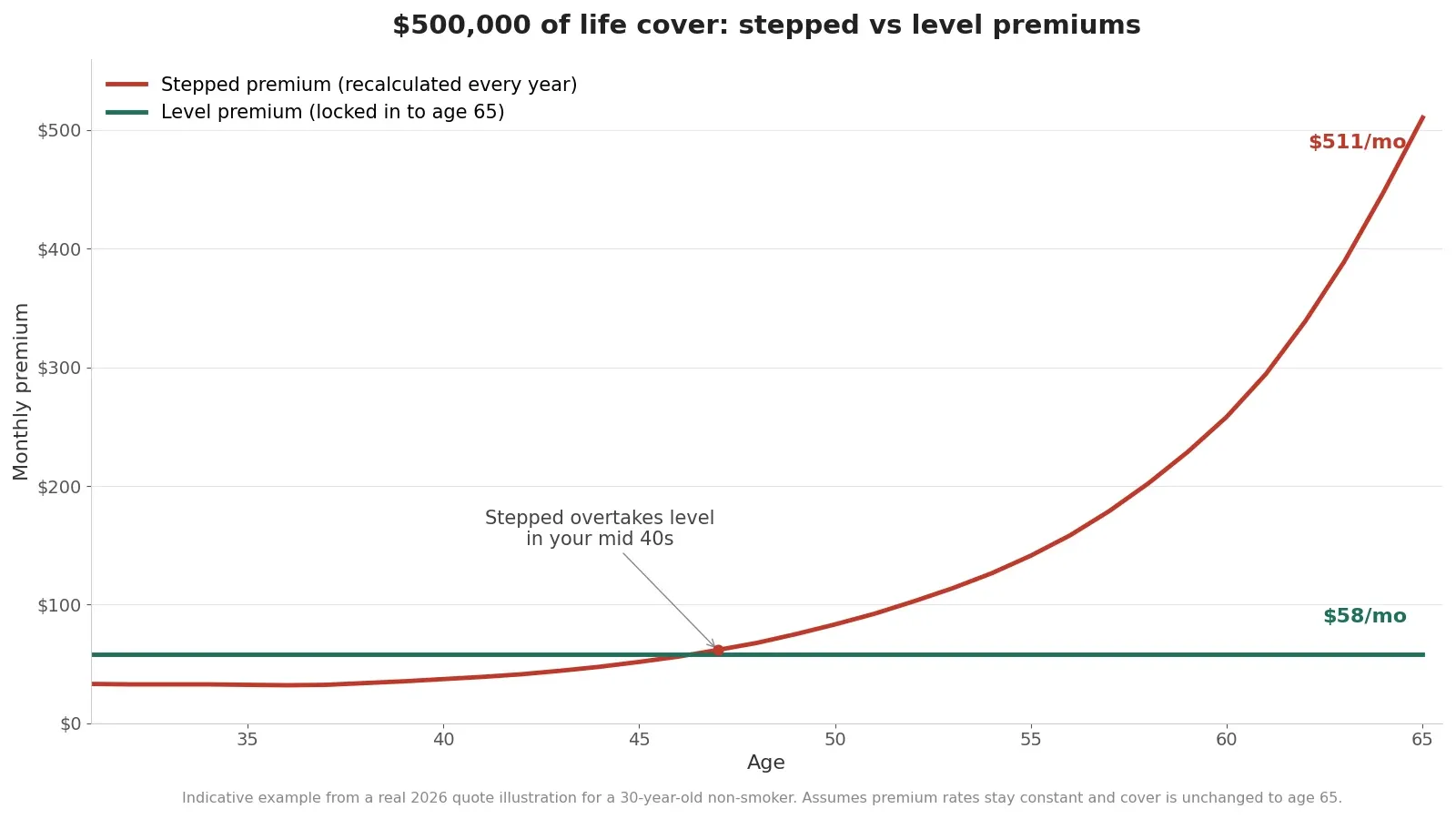
The stepped premium starts cheaper, around $33 a month against $58 for level. But it overtakes the level premium in the mid 40s and keeps climbing, reaching over $500 a month by age 65. In this illustration, someone who keeps their cover past their mid 50s comes out ahead overall on level premiums, and by 65 the difference in total premiums paid is around $29,000 on the life cover alone. Add trauma cover on the same structure and the projected difference comes to more than $74,000.
Two things to keep in mind with numbers like these. Projections assume premium rates stay constant and that the same cover is kept all the way to 65, so treat them as indicative rather than a promise. And level premiums are a commitment. Cancel in the early years and you’ve paid extra for nothing, so the maths works best on cover you know you’ll keep for the long haul.
Banks sell a limited shelf
Which brings us to the next point. When you arrange cover through your bank, you’re generally being offered one product, the bank’s own. There’s no comparison happening and no shopping around. You get what’s on the shelf.
That’s not necessarily a bad product. But it does mean you’ve got no idea whether you’re paying a fair price compared to what else is out there, and because there’s only one option, there’s no real pressure on the price. If you’re not even sure what type of cover the bank set you up with, our guide to life insurance vs mortgage cover walks through the difference.
Inflation gets baked in
A lot of policies have automatic increases built in to keep your cover in line with inflation, sometimes called indexation or CPI adjustments. The idea is sound. Half a million dollars of cover today won’t stretch as far in fifteen years, so the policy bumps up your cover amount, and your premium along with it, each year.
The catch is that this often happens automatically unless you opt out. So part of your increase might actually be your cover amount growing, not just the price of the same cover going up. Worth checking your annual letter to see which it is.
The insurer can reprice the whole book
Separate from your age-based increases, insurers can also raise premiums across an entire group of policyholders. If claims have been higher than expected, or their own costs have gone up, they can pass that on. You’ll usually see this described as a change to the “premium rates” rather than anything specific to you.
This doesn’t happen every year. But when it does, it can land on top of your normal age-related increase, which is why some years feel like a much bigger jump than others.
How long do you actually need the cover for?
Here’s a way of thinking about it that can save real money over the life of a policy. Your need for cover isn’t flat. It peaks when the kids are young, the mortgage is at its biggest, and your family depends most on your income. Once the kids leave home and the mortgage shrinks, you may simply need less cover than you started with. The goal has changed.
And later still, there can come a point where you don’t need much at all. Once you’ve built up enough in KiwiSaver, your home, and other assets, those can effectively do the job a life insurance policy used to do. Some people reach retirement needing only enough cover left to take care of a funeral.
If you think about that early, the policy can be set up around it: cover amounts and timeframes that match the years you actually need protection, premiums levelled over that period, and a plan to wind cover back as your assets grow. Insure while you need it, save while you don’t.
Why “I’ll sort it out later” can backfire
Switching or upgrading isn’t always available when you want it. Whenever you make a change that increases the insurer’s risk, like locking in level premiums (which signals you intend to keep the cover long term), increasing your cover amount, or adding products such as income protection or trauma cover (sometimes called critical illness cover), the insurer gets to reassess you first. That process is called underwriting, and insurers can and do say no.
The tricky part is that health rarely stands still. High blood pressure, raised cholesterol, diabetes, a higher BMI, or taking up smoking or vaping are all common findings, and any one of them can mean new cover comes with a higher price, an exclusion, or a straight decline. Plenty of people sit on age-based premiums intending to sort it out someday, then a health event happens and the door has partly closed.
One thing worth checking in your current policy: some insurers offer a level conversion option, which lets you switch to locked-in premiums later without going through medical questions again. If yours doesn’t have one, that’s another reason to look at your setup sooner rather than later, while your health is still on your side.
So what can you actually do about it?
The increases themselves aren’t a scam or a mistake. But that doesn’t mean you’re stuck with them, or that you’re getting the best deal. A few things are worth doing.
Read your annual review letter properly. It’ll spell out how much of the increase is age-related, how much is indexation, and whether any rate changes have been applied. Most people file it without opening it. And here’s something many people don’t realise: you can decline the indexation increase. It costs nothing, keeps your cover at its current level, and only takes a quick word with the insurer or a broker to say no to it.
Check whether your cover still fits. If your mortgage is smaller than it was, or the kids have left home, you might be paying for more cover than you actually need now. Trimming it back can take the sting out of the premium.
Get it reviewed by someone who can compare options. This is the big one. A bank can only offer you the bank’s product. A financial adviser can look across multiple insurers, compare what you’re paying against the market, and tell you whether a different policy, or a different premium structure, would serve you better. They can also help you lock in premiums you can actually keep as the years go on, rather than ones that price you out of your cover right when you’re most likely to need it.
The bottom line
Rising premiums on bank cover usually come down to a mix of getting older, inflation adjustments, and the simple fact that you were only ever shown one option. None of that is unusual. But it’s a good prompt to stop and ask whether the cover you set up years ago is still the right fit, and the right price, for where you are now.
If you’d like a no-obligation look at your current cover, we can connect you with a licensed financial adviser who can compare your options across the market, let you know where you stand, and look into whether level premiums suit your situation and could save you money over the life of your cover.
Get matched with a trusted insurance adviser →
This article is general information only and doesn’t take your personal circumstances into account. It isn’t financial advice. For advice tailored to your situation, speak with a licensed financial adviser.